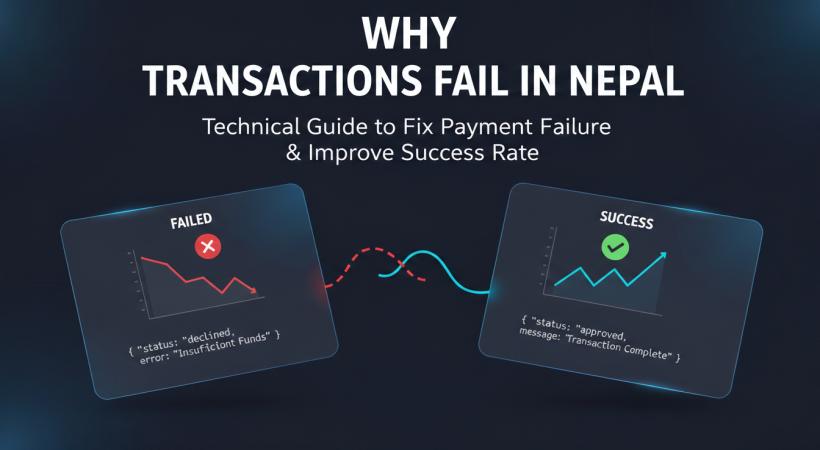
Why Transactions Fail in Nepal: Technical Guide to Fix Payment Failure & Improve Success Rate
Are you seeing frequent “transaction failed” errors in Nepal even when customers attempt to complete payment successfully?
Payment failure in Nepal is one of the most overlooked technical issues affecting online businesses. While many assume digital wallet downtime is the cause, most failed transactions are triggered by integration errors, callback misconfiguration, timeout issues, or improper verification logic.
If your website or application depends on digital payments, understanding the real causes of transaction failure is critical to improving your payment success rate.
This technical guide explains why transactions fail in Nepal and how to fix them properly.
> What Does “Transaction Failed” Mean?
A transaction failed Nepal error appears when the payment gateway cannot confirm, validate, or process the transaction correctly.
Payment failure can occur during:
• eSewa API integration
• Khalti API integration
• Fonepay QR integration
• IME Pay transactions
• Mobile banking payment processing
The failure may happen:
• Before payment authorization
• During API communication
• While verifying signature
• During callback processing
• After payment but before order update
Identifying where the failure occurs is the first step toward improving payment success rate.
1. Callback URL Misconfiguration
One of the most common causes of payment failure in Nepal is improper callback handling.
Typical issues include:
• Incorrect success or failure URL
• Expired or invalid SSL certificate
• Server blocking POST requests
• Wrong HTTP status response
• Firewall restrictions
• Misconfigured webhook endpoint
If the payment gateway cannot successfully send confirmation data to your server, it may mark the transaction as failed - even if the user paid successfully.
- How to Fix It
• Ensure HTTPS is correctly configured
• Always return HTTP 200 response on callback
• Log full callback payload for debugging
• Avoid redirecting before verifying payment
• Test callback endpoint independently
Correct callback configuration significantly improves payment gateway reliability.
2. Signature and Hash Verification Errors
Wallet providers like eSewa and Khalti require signature validation to ensure payment authenticity.
Common mistakes include:
• Incorrect secret key usage
• Wrong hashing algorithm
• Parameter mismatch
• Improper string formatting
• Encoding errors
• Skipping server-side validation
These mistakes lead to “invalid signature” errors and automatic transaction failure.
- How to Fix It
Follow official API documentation precisely
• Log the exact string used for hashing
• Perform verification only on server-side
• Compare expected and received signature values carefully
Signature mismatch is a major cause of payment failure Nepal cases.
3. API Timeout & Slow Backend Response
Payment gateways expect a response within a limited time window.
If your server:
• Executes heavy database queries
• Calls external APIs during verification
• Processes business logic before confirming payment
• Experiences high traffic load
The gateway may timeout and mark the transaction as failed.
- How to Fix It
• Return response immediately
• Use asynchronous background processing
• Optimize database queries
• Monitor server performance
• Implement caching where possible
Reducing latency directly improves payment success rate.
4. Duplicate Transactions & Idempotency Issues
If your system does not implement idempotency control, duplicate requests can cause payment failure.
This happens when users:
• Refresh payment page
• Click “Pay Now” multiple times
• Retry after network interruption
• Without unique transaction handling, systems may:
• Create duplicate orders
• Reject second attempt
Cause inconsistent payment states
- How to Fix It
• Generate unique order IDs
• Implement idempotency keys
• Check transaction status before creating new record
• Prevent duplicate processing logic
Proper request control reduces transaction failed Nepal errors significantly.
5. Settlement Mismatch vs Payment Confirmation
Sometimes payment is successful in wallet, but merchant dashboard shows failed.
Common causes:
• Callback not stored in database
• Order status not updated properly
• Payment verification skipped
• Settlement reconciliation not performed
This creates confusion and customer complaints.
- How to Fix It
• Separate payment status from order status
• Store raw gateway response
• Reconcile transactions daily
• Maintain transaction audit logs
Accurate reconciliation improves operational stability.
6. Wallet-Specific Integration Issues in Nepal
Different wallets behave differently.
- eSewa Integration Issues
• Incorrect product code
• Wrong merchant ID
• Test and live environment mismatch
• Hash generation errors
- Khalti API Issues
• Token verification skipped
• Secret key mismatch
• Incorrect public/private key usage
• Environment confusion
- Fonepay QR Integration Issues
• Static QR amount mismatch
• Delay in bank confirmation
• Improper callback mapping
• Manual reconciliation errors
Treating all wallets with identical logic increases payment failure risk.
7. Poor Checkout Error Handling
Many businesses display only: “Transaction Failed.” Without explaining why. This increases abandonment and reduces customer trust.
- Checkout Optimization Best Practices
• Show clear, actionable error messages
• Provide immediate retry option
• Offer alternate payment method
• Preserve cart session
• Log error codes for backend review
Better checkout handling improves conversion rate and payment success.
8. Lack of Real-Time Monitoring
Most businesses do not track:
• Payment failure percentage
• Wallet-specific error rate
• API response time
• Callback delivery success
• Peak-hour performance
Without monitoring, reducing payment failure becomes reactive rather than proactive.
Implement analytics and logging to identify failure patterns early.
> How to Improve Payment Success Rate in Nepal
To improve payment success rate:
• Validate transactions server-side
• Optimize backend response time
• Monitor API performance
• Implement retry mechanisms
• Support multiple wallet options
• Use dynamic QR for accurate payments
• Maintain clean settlement reconciliation
Payment reliability is a technical discipline, not just a feature.
> How ApiNepal Helps Reduce Payment Failure
ApiNepal improves payment success rate in Nepal by offering:
✔ Unified API integration
✔ Standardized callback handling
✔ Centralized transaction logging
✔ Multi-wallet routing
✔ Real-time monitoring dashboard
✔ Simplified reconciliation process
✔ Reduced integration complexity
By eliminating fragmented wallet integrations, technical error probability decreases significantly.
This results in fewer “transaction failed” errors and improved digital payment reliability.
> Final Thoughts
Payment failure in Nepal is often caused by technical implementation weaknesses rather than wallet downtime.
Improper API integration, callback misconfiguration, timeout errors, signature mismatch, and lack of monitoring are the most common reasons behind transaction failed errors.
By strengthening backend logic, improving checkout handling, and using a unified payment gateway solution like ApiNepal, businesses can significantly improve payment success rate and protect revenue.
Reducing transaction failure is not just a technical improvement - it is a direct path to higher conversion and sustainable growth.