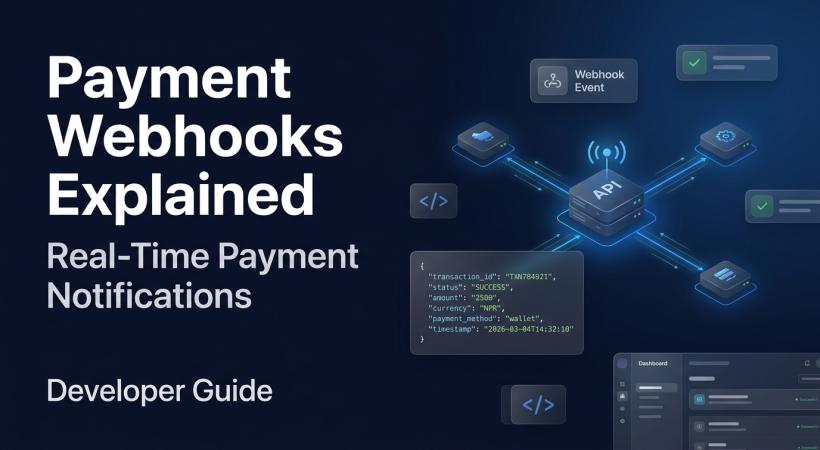
Payment Webhooks Explained: How Real-Time Payment Notifications Work in Nepal (Developer Guide)
Modern digital payment systems depend heavily on real-time communication between payment gateways and merchant servers. When a payment is completed, the merchant’s system must instantly receive confirmation to update orders, activate services, or deliver digital products.
This is where payment webhooks come into play.
In this guide, we explain what payment webhooks are, how they work, and why they are essential for real-time payment confirmation in Nepal’s digital payment ecosystem.
> What Is a Payment Webhook?
A payment webhook is an automated HTTP callback sent by a payment gateway to a merchant’s server when a transaction event occurs.
Instead of repeatedly checking the payment status through an API request, the payment gateway pushes the transaction information directly to your system in real time.
Common Payment Events Sent Through Webhooks
• Payment successful
• Payment failed
• Transaction pending
• Refund processed
• Settlement completed
Webhooks allow applications to automatically react to these events without manual verification.
> Why Webhooks Are Important for Online Payments
In Nepal’s growing digital commerce market, merchants rely on instant payment confirmations to deliver a seamless user experience.
Without webhooks, systems would need to constantly query the payment gateway for updates, which is inefficient and slow.
Key Benefits of Payment Webhooks
1. Real-Time Payment Confirmation
Merchants receive instant transaction updates, enabling immediate order processing.
2. Automated Workflow
Webhooks can automatically trigger actions such as:
• Order confirmation
• Account activation
• Subscription renewal
• Digital product delivery
3. Reduced API Requests
Instead of polling the payment API repeatedly, the gateway sends updates automatically.
4. Improved System Reliability
Webhooks ensure your system stays synchronized with payment events even if the user closes the browser.
> How Payment Webhooks Work (Step-by-Step)
Here is the typical webhook flow during a payment transaction:
• A customer initiates a payment on a merchant’s website or application.
• The payment is processed through the gateway.
• Once the transaction status changes, the payment system sends a webhook notification to the merchant’s server.
• The merchant’s backend verifies the request.
• The system updates the transaction status and completes the order.
This process usually happens within seconds.
> Example: Webhook Data Structure
A typical webhook payload sent by a payment gateway may look like this:
{
"transaction_id": "TXN784921",
"status": "SUCCESS",
"amount": "2500",
"currency": "NPR",
"payment_method": "wallet",
"timestamp": "2026-03-04T14:32:10"
}
Your backend server receives this data and updates the order status accordingly.
> Payment Webhooks in Nepal’s Digital Payment Ecosystem
Nepal’s digital payment infrastructure is regulated by Nepal Rastra Bank and supported by multiple wallet providers and payment networks.
Major platforms include:
• Fonepay
• eSewa
• Khalti
• IME Pay
For developers integrating payment gateways in Nepal, webhooks are critical for handling real-time transaction status updates and reconciliation processes.
> Webhooks vs API Polling
Many developers initially check payment status using repeated API requests. However, webhook-based architecture is far more efficient.
| Feature | Webhooks | API Polling |
|---|---|---|
| Update Method | Gateway pushes data | Merchant repeatedly requests status |
| Speed | Real-time | Delayed |
| Server Load | Low | High |
| Efficiency | High | Lower |
Because of these advantages, modern payment APIs recommend webhook integration.
> Security Best Practices for Payment Webhooks
Since webhooks involve server-to-server communication, security is extremely important.
Recommended Security Measures
- Verify webhook signatures
Most payment gateways send a digital signature to confirm authenticity.
- Use HTTPS endpoints
Webhook URLs must always use secure HTTPS connections.
- Validate transaction IDs
Ensure the transaction exists in your database before updating order status.
- Prevent replay attacks
Reject duplicate webhook requests for the same transaction.
Implementing these safeguards ensures secure webhook processing.
> Common Use Cases for Payment Webhooks
Payment webhooks are widely used across various online businesses.
- eCommerce Platforms
Automatically confirm orders after payment success.
- SaaS Platforms
Activate subscriptions once payment is verified.
- Digital Product Stores
Deliver downloadable products instantly.
- Event Ticketing Platforms
Generate and send digital tickets automatically.
Without webhook automation, these processes would require manual verification.
> Why Developers Should Implement Webhooks Early
Developers integrating payment gateways often underestimate the importance of webhook architecture.
Implementing webhooks early ensures:
• Accurate transaction tracking
• Reliable payment confirmation
• Better system automation
• Reduced operational workload
In modern fintech systems, webhook-based event handling is considered a best practice.
> Future of Payment APIs in Nepal
As Nepal’s fintech ecosystem grows, payment infrastructure will increasingly rely on API-driven and event-based systems.
Developers can expect:
• Advanced webhook event systems
• Real-time transaction monitoring
• Improved fraud detection mechanisms
• Faster settlement notifications
Businesses adopting webhook-driven payment integration will be better prepared for these developments.
> Conclusion
Payment webhooks play a critical role in modern digital payment systems. They allow payment gateways to send real-time transaction notifications directly to merchant servers, enabling automated order processing and seamless customer experiences.
For developers building payment-enabled applications in Nepal, webhook integration is essential for ensuring reliable payment confirmation and efficient system architecture.
As Nepal’s digital payment ecosystem continues to expand, webhook-based payment communication will remain a key component of scalable fintech infrastructure.