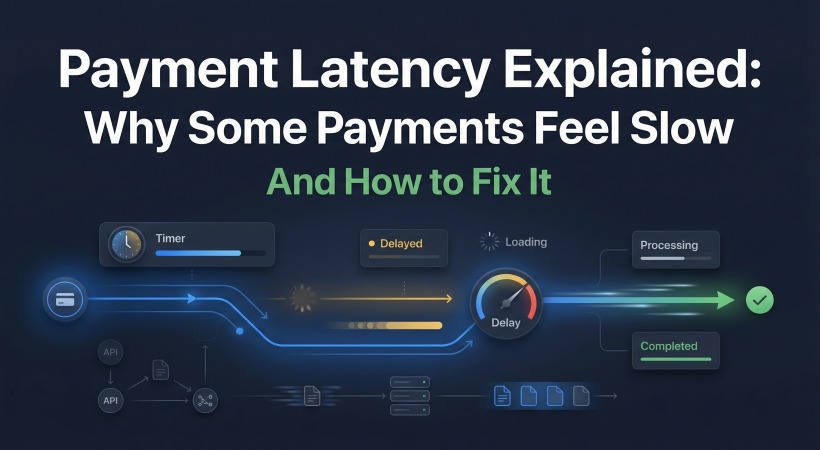
Payment Latency Explained: Why Some Payments Feel Slow
Payment Latency Explained: Why Some Payments Feel Slow (And How to Fix It) (2026 Guide)
In today’s digital economy, customers expect payments to be instant. Whether it’s an eCommerce checkout, QR scan, or mobile wallet payment, even a few seconds of delay can create doubt and lead to abandoned transactions.
But behind every “slow payment” is a technical concept called payment latency.
In this SEO-optimized guide, we explain what payment latency is, why payments feel slow in Nepal, and how businesses and developers can reduce delays to improve conversion rates and user experience.
> What Is Payment Latency?
Payment latency refers to the time it takes for a payment transaction to be processed from initiation to confirmation.
This includes:
• Request sent from user device
• Payment gateway processing
• Bank or wallet authorization
• Response returned to merchant
Even a delay of 2–5 seconds can feel slow to users, especially on mobile devices.
> Why Do Payments Feel Slow?
Payment latency is not caused by a single system — it happens due to delays across multiple layers.
1. Network Latency
Slow internet connections (especially mobile data) can delay communication between:
• User device
• Merchant server
• Payment gateway
In Nepal, varying network quality can significantly affect payment speed.
2. Payment Gateway Processing Time
Payment gateways process:
• Transaction validation
• Fraud checks
• Routing decisions
If the system is under heavy load or not optimized, latency increases.
3. Banking System Response Time
Banks play a critical role in authorization.
Delays can occur due to:
• Server load
• Maintenance windows
• Internal processing delays
All payment systems in Nepal operate under the regulatory framework of Nepal Rastra Bank, and bank-level latency can affect overall transaction speed.
3. Wallet Authentication Flow
Wallet-based payments (common in Nepal) involve:
• App switching
• User authentication
• OTP or PIN verification
Platforms like:
• eSewa
• Khalti
• IME Pay
may introduce additional steps that increase perceived latency.
4. Payment Redirect Flow
When users are redirected between pages (merchant → gateway → bank → back), delays may occur due to:
• Page load time
• Server response time
• DNS resolution
5. API Performance Issues
Poorly optimized payment APIs can cause:
• Slow request handling
• Timeout errors
• Delayed responses
This is especially critical for developers integrating payment systems.
> Types of Payment Latency
Understanding latency types helps diagnose issues.
- Client-Side Latency
Delay caused by user device or internet connection.
- Network Latency
Delay in communication between servers.
- Processing Latency
Time taken by gateway and bank to process the transaction.
- Perceived Latency
How slow the payment feels to the user (UX factor).
> Why Payment Latency Matters for Businesses
Payment latency directly impacts revenue and user experience.
- Lower Conversion Rates
Users abandon payments if the process feels slow or stuck.
- Reduced Trust
Slow payments create uncertainty about whether the transaction succeeded.
- Increased Support Issues
Customers may report duplicate payments or failures due to confusion.
> Payment Latency in Nepal’s Digital Ecosystem
Nepal’s payment infrastructure includes:
• Fonepay
• eSewa
• Khalti
• IME Pay
While these systems are optimized for mobile-first usage, latency can still occur due to:
• Network variability
• Bank dependencies
• Multi-step authentication
> How to Reduce Payment Latency (Actionable Strategies)
- Optimize Checkout Flow
• Reduce unnecessary steps
• Minimize page redirects
• Use lightweight UI components
- Improve API Performance
• Use fast server infrastructure
• Optimize backend processing
• Reduce response time
- Enable Smart Payment Routing
Route transactions through the fastest available payment channel.
- Use Webhooks Instead of Polling
Webhooks provide instant updates instead of repeated API requests.
- Optimize for Mobile Networks
• Test on slow connections (3G/4G)
• Compress assets
• Reduce page load time
- Monitor Payment Performance Metrics
Track:
• Payment response time
• Success rate
• Drop-off rate
This helps identify latency bottlenecks.
> Future of Faster Payments in Nepal
Nepal’s digital payment ecosystem is evolving toward:
• Real-time payment systems
• Improved banking APIs
• Faster QR-based transactions
• Enhanced infrastructure reliability
As systems mature, payment latency will continue to decrease.
> Final Conclusion
Payment latency is a critical factor in digital payment performance. Even small delays can impact conversions, trust, and customer satisfaction.
By understanding the causes of slow payments and implementing optimization strategies, businesses and developers in Nepal can deliver faster, more reliable payment experiences.
In a competitive digital market, speed is not optional — it is a key driver of success.