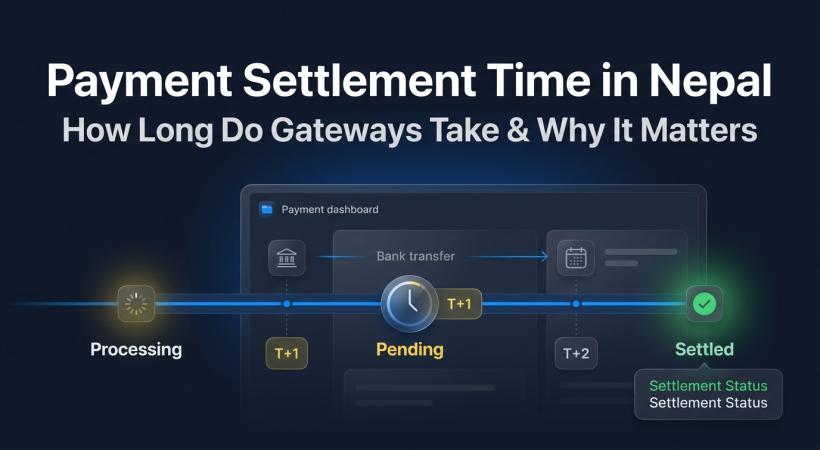
Payment Settlement Time in Nepal: How Long Do Gateways Take & Why It Matters
For most online businesses in Nepal, getting paid is not the same as receiving money in the bank.
A customer completes a transaction instantly but when do you actually receive the funds?
Understanding payment settlement time Nepal is critical for managing cash flow, planning expenses, and scaling operations.
In this guide, we explain:
• What payment settlement means
• Payment gateway settlement Nepal timelines
• T+1 vs T+2 settlement cycle Nepal
• Wallet vs bank settlement differences
• Why settlement delays happen
• How to reduce payout issues
• Why structured infrastructure improves settlement visibility
> What Is Payment Settlement?
Payment settlement is the process of transferring funds from a customer’s payment method to the merchant’s bank account.
When a customer pays:
• Transaction is authorized
• Payment is processed
• Funds are captured
• Settlement cycle begins
• Money is transferred to merchant account
The time between capture and transfer is called settlement time.
> Payment Settlement Time Nepal – How Long Does It Take?
Settlement time depends on:
• Payment provider
• Wallet or bank method
• Merchant agreement
• Processing volume
• Business category
In Nepal, typical settlement cycles include:
• T+1 settlement Nepal (Next business day)
• T+2 settlement Nepal (Two business days)
• Scheduled weekly settlement
• Custom volume-based settlement
• “T” refers to the transaction day.
For example:
T+1 → Payment made Monday, settled Tuesday
T+2 → Payment made Monday, settled Wednesday
Understanding your settlement cycle Nepal helps avoid cash flow surprises.
> eSewa Settlement Time & Khalti Settlement Time
Many merchants ask:
- How long do eSewa or Khalti payments take to settle?
While exact terms depend on agreements, wallet-based payments often follow structured settlement cycles.
Factors affecting settlement:
• Merchant onboarding category
• Transaction volume
• Refund or dispute activity
• Weekend and holiday schedules
• Compliance checks
It is important to clarify payout terms before integration.
> Wallet vs Bank-Based Settlement in Nepal
Different payment methods may follow different settlement structures.
| Payment Method | Typical Settlement Model |
|---|---|
| Digital Wallet | T+1 or T+2 |
| Bank Transfer (ConnectIPS) | Bank clearing cycle |
| QR Payment | Wallet or bank linked cycle |
| Card Payment | Network-based cycle |
Digital payment settlement Nepal is not always instant, even if transaction confirmation is immediate.
> Why Payment Settlement Time Matters
Many merchants underestimate settlement timing.
It directly affects:
1. Cash Flow Management
Delayed settlement impacts operational planning.
2. nventory & Procurement
Retail businesses need predictable payout cycles.
3. Salary & Vendor Payments
Settlement timing affects expense scheduling.
4. Business Scalability
Fast and predictable settlement supports growth.
Understanding merchant payout time Nepal is essential for financial stability.
> Common Reasons for Settlement Delays
Even with structured cycles, delays may occur due to:
• Public holidays
• Bank clearing delays
• Compliance review
• High transaction volume
• Fraud or dispute checks
• Incomplete merchant documentation
• Settlement reconciliation issues
Most delays are operational not technical.
> How to Reduce Settlement Issues
To improve payment gateway settlement Nepal efficiency:
✔ Understand Your Agreement
Clarify T+1 or T+2 terms clearly.
✔ Maintain Clean Transaction Records
Disputes can delay payout cycles.
✔ Monitor Chargeback Ratio
High disputes increase settlement scrutiny.
✔ Keep Compliance Updated
Outdated documents may trigger review delays.
✔ Use Centralized Monitoring
Unified dashboards improve visibility.
Good operational discipline improves payout consistency.
> Real-Time Transaction vs Settlement – Important Difference
Many merchants confuse:
Transaction confirmation vs Bank settlement
Transaction confirmation = payment approved.
Settlement = funds transferred to merchant account.
Instant checkout does not mean instant payout.
Understanding this difference prevents accounting confusion.
> How ApiNepal Improves Settlement Visibility
While settlement cycles are determined by payment networks and agreements, infrastructure plays a major role in transparency and reconciliation.
ApiNepal enhances payment gateway settlement Nepal experience through:
✔ Centralized transaction dashboard
✔ Unified reporting across wallets
✔ Clear settlement tracking
✔ Structured reconciliation tools
✔ Reduced fragmented integrations
✔ Standardized callback validation
Instead of checking multiple wallet dashboards separately, merchants get consolidated visibility.
Better visibility improves financial planning.
> Settlement Cycle Nepal – What Growing Businesses Should Negotiate
As transaction volume increases, merchants can often negotiate:
• Faster settlement cycle
• T+1 upgrade
• Custom payout scheduling
• Higher daily payout limits
Volume-based negotiation becomes easier with clean operational history.
> Who Should Care Most About Payment Settlement Time?
Settlement timing is especially critical for:
• eCommerce businesses
• Travel agencies
• High-volume online stores
• Subscription platforms
• Marketplace operators
• Digital product sellers
If daily revenue drives operations, settlement delay directly affects liquidity.
Frequently Asked Questions(FAQ)
- What is payment settlement time Nepal?
It is the time between transaction completion and fund transfer to the merchant’s bank account.
- How long does payment gateway settlement Nepal take?
Typically T+1 or T+2 business days, depending on provider and agreement.
- Is digital payment settlement Nepal instant?
Transaction confirmation may be instant, but bank settlement usually follows structured cycles.
- Can merchants negotiate faster settlement?
Yes. High-volume merchants can often negotiate improved settlement terms.
Final Thoughts
Understanding payment settlement time Nepal is essential for serious online businesses.
While customers pay instantly, actual merchant payout follows structured settlement cycles.
Knowing your payment gateway settlement Nepal timeline helps:
• Manage cash flow
• Plan expenses
• Reduce financial surprises
• Improve operational efficiency
A centralized and well-structured payment infrastructure like ApiNepal improves settlement visibility, reconciliation clarity, and operational transparency.
In digital commerce, revenue timing matters just as much as revenue generation.